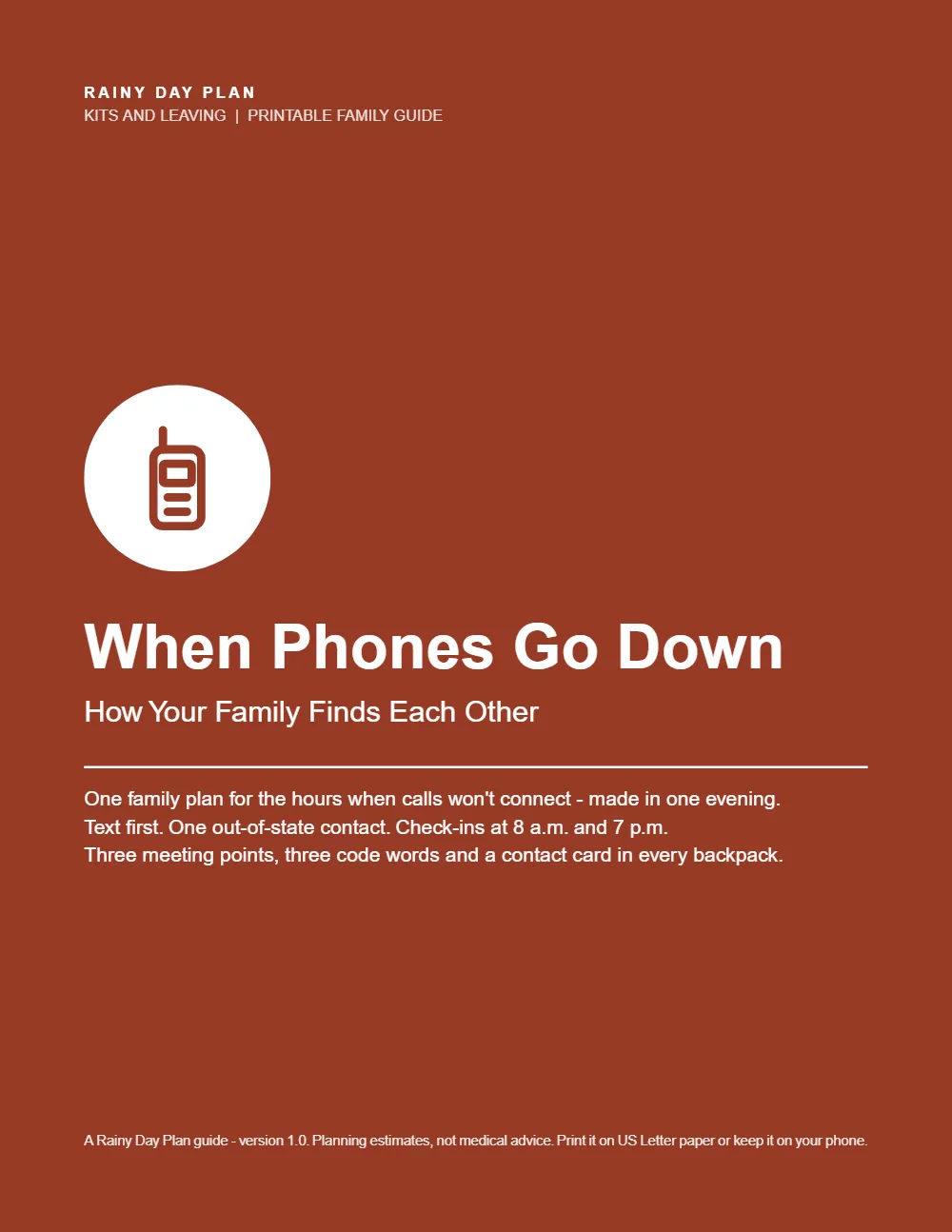
When Phones Go Down
How Your Family Finds Each Other
The storm has passed, but the phone shows one bar, then none. One parent is at work across town, the kids are at school, and the call you try won't go through. Who goes where, and how does everyone learn the others are okay?
Settle in one evening how your family finds each other when calls won't connect - who to text, when to check in and where to meet.
$12 - instant PDF, 27 pages, printable
30-day money-back guarantee - you keep the PDF.
Pay with Apple Pay, Google Pay, Link or card. Secure checkout by Stripe.
Add the Printable Quick Cards for $7 with one tick on the checkout page.
What you'll do with it
- Text first, call second: one message under 30 words - WHO - WHERE - STATUS - NEED - to one out-of-state contact who passes the news along.
- Set two check-in times, for example 8 a.m. and 7 p.m., and three code words that turn a whole message into one word.
- Pick three meeting points - near home, in the neighborhood and out of town - and visit each one with the kids.
- Keep news and family in reach with no signal: a weather radio, walkie-talkies, offline maps and satellite SOS on newer phones.
- Put a contact card in every backpack, and run a 30-minute drill twice a year, when the clocks change.
Look inside
Real pages from this guide. Tap a page to see it up close.
Start here
Where to begin, and every card with its page number.
One action per page
Time, cost, the steps in order, and what not to do.
Pages you fill in
Your family's own numbers, written down before you need them.
What's inside
- The First Hour Without Signal
- What Fails First
- Text First, Call Second
- Keep Phones Charged
- The Out-of-State Contact
- Check-In Times and Code Words
- The 30-Word Message
- Three Meeting Points
- Weather Radio and News Without Internet
- Walkie-Talkie Radios: FRS and GMRS
- Satellite SOS on Newer Phones
- Maps That Work Offline
- School Pickup When Phones Fail
- A Contact Card in Every Backpack
- The Twice-a-Year Drill
The key numbers come from FEMA, FCC, NOAA and the Red Cross - listed in the back.
This weekend
- Call your out-of-state contact and ask them to be the family's check-in person.
- Visit all three meeting points as a family, then fill in the Meeting Places page.
- Fill in a Kids' Contact Card for every backpack, and a wallet copy for each adult.
Try it for 30 days. If it doesn't help, email us and we'll refund you.
Also in
- The Complete Home Readiness Library - $59 (Bought one by one: $285)
- The Leave-Fast Bundle - $27 (Bought one by one: $36)
Questions people ask
- Is this a printed book?
- No - it's an instant PDF. Print it at home on US Letter paper, or keep it on your phone.
- Does it work where I live?
- Yes. The guides are written for American homes in every state: gallons, °F, US weather and US stores.
- Do I need to buy a lot of gear?
- No. Most first steps use what's already in your house. When you're ready to buy, the guide shows what comes first.
- Is this medical advice?
- No. It's planning information. Talk to your doctor, pharmacist or equipment supplier about medicines and medical devices.
- How do I get it?
- Right after you pay: a download on the thank-you page, and an email with your download links. The links keep working.
- How is this different from the Personal Plan?
- A guide shows you how to get ready. The Personal Plan does the math for your household - your gallons, your days of food, your battery size and a shopping list.
Questions? Email get-ready@myrainydayplan.com.
$12 - instant PDF, 27 pages, printable
30-day money-back guarantee - you keep the PDF.
Want the numbers worked out for your family?
The guides show you how. The Personal Plan does the math for your household - your gallons of water, your days of food, the battery size for your devices, and a shopping list. It starts with 5 free questions.
Take the free 60-second check